转译自世界黑白棋联盟
SPOILER: THE ANSWER IS NOT A NUMBER
剧透:答案不是一个数字
Back when I was young and naive, still poring over books to improve my chess game, I came across that famous quote by the Czechoslovakian Grandmaster Richard Réti. When asked how many moves he typically calculated during a match, he would reply: “As a rule, not a single one.” He was always careful to emphasize that he was being entirely sincere. That answer carried a very specific meaning: it served to highlight that raw prediction is not the only way to play well—nor is it necessarily the most important. Instead, it points to other approaches we humans use to excel in complex games like chess, Othello, or Go.
当我年轻时还很天真,仍然埋头苦读棋书以提升棋艺的时候,我读到了那位捷克斯洛伐克特级大师Richard Réti的名言。当被问及他在比赛中通常计算多少步棋时,他会回答:“一般来说,一步也不算。”他总是小心地强调,他完全是真诚的。这个答案有着非常具体的含义:它旨在强调,纯粹的预测并非下好棋的唯一方式——也未必是最重要的方式。相反,它指出了我们人类在象棋、黑白棋或围棋这类复杂游戏中用以表现出色的其他方法。
The Artist and The Engineer/艺术家与工程师
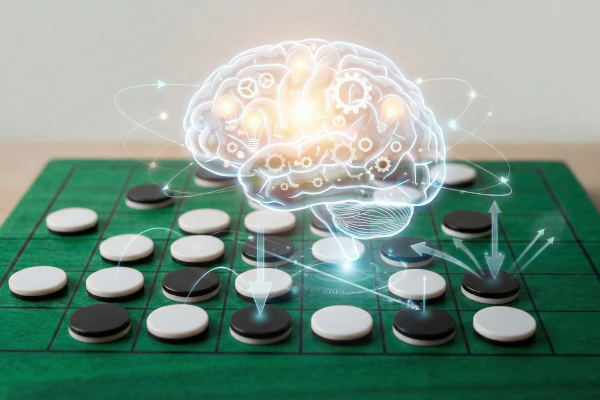
Focusing our attention on our predictive capabilities—the ability to see the board ahead in time—is a perfectly valid pursuit. This is especially true in modern times, as we witness computers and artificial intelligences excel at the games we love through their sheer raw computing power. The truth, however, is that there are two possible thinking methods to use when we evaluate the best move in Othello (or any other complex abstract game):
将注意力集中在我们的预测能力上——即在时间上向前看棋盘的能力——是一种完全合理的追求。这在现代尤其如此,因为我们看到计算机和人工智能通过其强大的原始计算能力在我们喜爱的游戏中表现出色。然而,事实是,当我们评估黑白棋(或任何其他复杂抽象游戏)的最佳着法时,有两种可能的思考方法:
- The Positional Approach: This analyzes patterns and the relative strengths of the position on the board. It identifies one or more good moves that aim primarily to create a position which “feels” solid or, at the very least, provides us with a sense of confidence.
- The Predictive Approach: This involves a separate evaluation of various possible moves. For each one, the player carries out the sequence ‘in their mind,’ anticipating the opponent’s responses, exploring decision trees of varying depths, and often counting the discs gained as the analysis progresses.
- 局面性方法: 这种方法分析棋盘上的模式和局面的相对强弱。它找出一个或多个好棋,这些棋主要旨在创造一个“感觉”稳固、或至少能给我们带来信心的局面。
- 预测性方法: 这涉及对各种可能的着法进行独立的评估。对于每一种着法,棋手在“脑海中”执行这个序列,预判对手的回应,探索不同深度的决策树,并常常在分析过程中计算获得的棋子。
In some ways, these can be seen as the classic distinction between playing by ‘instinct’ versus ‘reasoning.’ In the gaming world, they are often labeled as the ‘romantic/artistic’ style versus the ‘analytical/engineering’ style. Game theory calls the former ‘heuristics,’ as opposed to exhaustive analysis. Daniel Kahneman would likely reach for his book Thinking Fast and Slow and zscream “hey, this is what I called ‘System 1 and System 2’ thinking!”. All are valid and complementary ways of saying the same thing.
在某种程度上,这可以看作是经典的“直觉”与“推理”之间的区别。在博弈世界中,它们通常被贴上“浪漫/艺术”风格与“分析/工程”风格的标签。博弈论称前者为“启发式方法”,以区别于穷举分析。 Daniel Kahneman可能会抓起他的书《Thinking Fast and Slow/思考,快与慢》并喊道:“嘿,这就是我所说的‘系统1和系统2’思考方式!”。所有这些说法都是有效且互补的。
“If I Were a Computer…”/“如果我是一台计算机……”
Both approaches achieve their goal, and when refined, lead to consistently good results. The predictive approach, however, is extremely challenging in terms of mental energy: it consumes resources on a massive scale and can lead us into a state of exhaustion that is difficult to recover from quickly. This is why we frequently fall back on the positional approach, which in its purest sense is an ‘absence of reasoning’: the brain provides an immediate response without conscious thought — a result of patterns recognized from past experiences, sequences seen in similar cases, or (to touch on a hot topic of the moment) lines memorized during study (memory doesn’t use computational power). The more tired we are, the more easily our brain defaults to the positional approach. The risk, however, is that a purely positional view can hide pitfalls that aren’t immediately visible—unexpected responses or traps that an opponent can spring to turn the game in their favor.
两种方法都能达到其目的,并且经过完善后,都能带来持续良好的结果。然而,预测性方法在脑力消耗方面极具挑战性:它大量消耗资源,并可能使我们陷入一种难以快速恢复的疲惫状态。这就是为什么我们经常依赖局面性方法,从最纯粹的意义上讲,它是一种“无推理”:大脑无需有意识的思考,基于从过往经验中识别的模式、在类似情况下见过的棋局序列、或(为了提及当下的一个热门话题)在研究中记忆的套路(记忆不使用计算能力),提供即时反应。我们越疲惫,大脑就越容易默认采用局面性方法。然而,风险在于,纯粹的局面性观点可能会隐藏那些并非立即可见的陷阱——对手可能发动意想不到的回应或陷阱,从而扭转局势。
If we were computers, we would do nothing but use the predictive approach for every single move, pushing our brains as far as possible every time it was our turn. This would be equivalent to calculating exactly how many degrees to turn the steering wheel before approaching every curve: not only humanly impossible, but completely ineffective in terms of the effort-to-result ratio. Being human, we are better than computers at something else: “eyeballing” a situation, obtaining a general sense of a move’s value almost instantly, albeit with a certain margin of error. A computer might say: “If I were human, I’d avoid brute-forcing every branch of the decision tree and would prune half the nonsensical moves right away using ‘instinct’ — but alas, I have no instinct!” While we sweat blood to improve our analytical skills, computers would trade half their computational power for our ‘artistic/romantic’ abilities and our capacity for immediate evaluation.
如果我们是一台计算机,我们就会为每一步棋都只使用预测性方法,在每一次轮到自己时都将大脑推向极限。这相当于在接近每一个弯道之前,都精确计算方向盘需要转动多少度:这不仅人力所不能及,而且从努力与结果的比率来看也完全无效。作为人类,我们在某些方面比计算机更擅长:“目测”一个情况,几乎瞬间获得对一步棋价值的总体感觉,尽管存在一定的误差范围。计算机可能会说:“如果我是人类,我会避免用蛮力计算决策树的每一个分支,会直接用‘直觉’剪掉一半无意义的着法——但是,唉,我没有直觉!”当我们竭尽全力提升自己的分析技能时,计算机宁愿用它们一半的计算能力来换取我们的“艺术/浪漫”能力以及我们即时评估的本事。
The Glucose Gambit: It’s a Very Very Risky World/葡萄糖赌注:这是一个非常非常冒险的世界
By now, it should be clear where I’m going with this article, which starts with a question and spends three-quarters of the text doing everything to avoid answering it.
至此,应该清楚我这篇以一个问题开始、却花了四分之三篇幅做一切努力来避免回答它的文章,其主旨何在了。
The point is: reducing our skill at Othello to a simple numerical measure of the moves we predict is both misleading and counterproductive. “Playing Othello well” means finding the ideal mix between the analytical and positional approaches. It’s not so much about how many moves we can predict, but how good we are at determining when it’s time to calculate and when it’s better to save our energy and trust our positional vision. The experience of great players allows them to recognize, better than anyone else, exactly when to stop and reason, knowing how much room they can afford to give to the calculation phase. The positional approach serves to prune the possibilities that require deeper analytical scrutiny; expert players are simply those who have found a better balance between the two.
关键在于:将我们在黑白棋上的技能简化为一个衡量我们预测步数的简单数字,既是误导性的,也是适得其反的。“下好黑白棋”意味着在分析性和局面性方法之间找到理想的混合。这与其说关乎我们能预测多少步棋,不如说关乎我们是否善于判断何时该计算、何时该节省精力并信任我们的局面视野。伟大棋手的经验使他们能够比任何人更好地识别,何时该停下来推理,知道他们能给计算阶段留出多大空间。局面性方法的作用在于修剪那些需要更深层次分析审视的可能性;专家棋手只不过是那些在这两者之间找到了更好平衡点的人。
The greater the experience, the easier it is to recognize when a position carries the risk of a superficial analysis. Experience also helps limit the ‘directions’ the analysis takes and teaches us when it’s okay to stop the predictive process. Playing Othello is always a battle against time, as well as against our own computational limits. Therefore, true talent isn’t the number of moves we can calculate, but knowing when to dive deep and when to pull back. It’s a fascinating mix of emotional management, preparation, and knowledge of one’s own limits and strengths. Improving at Othello doesn’t necessarily mean increasing the depth of our evaluations; it means being able to identify with greater precision when an analysis is sufficient, when it’s excessive, and when it’s lacking. It’s about establishing the best approach in terms of the risk of making a losing move, the risk of running out of time, and the risk of depleting the glucose circulating in our bodies.
经验越丰富,就越容易识别一个局面是否带有肤浅分析的风险。经验也有助于限制分析所采取的“方向”,并教会我们何时可以停止预测过程。下黑白棋始终是一场与时间的战斗,也是一场与我们自身计算极限的战斗。因此,真正的天赋不在于我们能计算多少步棋,而在于知道何时深入探究,何时及时抽身。这是一种情绪管理、准备程度以及了解自身局限与优势的迷人结合。提高黑白棋水平并不一定意味着增加我们评估的深度;它意味着能够更精确地识别一次分析何时足够、何时过度、何时不足。这涉及到在走出一步败着、时间耗尽以及耗尽体内循环的葡萄糖这三重风险之间,确立最佳应对方法。
In short, it’s a world full of risks, and navigating it is practically impossible. ‘Experienced’ players are often better than us at Othello, but understanding exactly why they are better isn’t easy (and if you ask them, they often won’t know what to tell you). So, we are left to study, explore our limits and the quirks of human reasoning, try different approaches to test their validity, and… play, play, and play some more. Because when it comes to accumulating experience, you can never go wrong.
简而言之,这是一个充满风险的世界,在其中航行几乎是不可能的。“有经验的”棋手在黑白棋上通常比我们更强,但要确切理解他们为何更强并不容易(如果你问他们,他们也常常不知如何作答)。所以,我们只能学习、探索我们自身极限和人类推理的奇特之处,尝试不同方法来检验它们的有效性,然后……下棋,下棋,再下棋。因为说到积累经验,你永远不会错。
