转译自世界黑白棋联盟
原文地址:https://www.worldothello.org/news/455/world-othello-championship-2026
Written by Carlo Affatigato
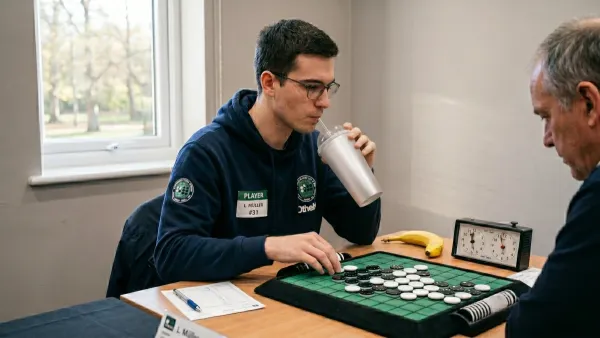
I know exactly what you’re up to the moment my back is turned. You’ve probably caught me at tournaments looking… let’s say, eccentric. You’ve seen me fussing over jars of jam and mysterious juice bottles, and you’ve definitely heard me preaching to anyone within earshot about what you absolutely should not touch for lunch. I can practically hear your inner monologue: “An article on tournament diet, really? What are you now, a nutritionist?”
我太清楚你们趁我转身的时候在琢磨什么了。你们大概早就注意到我在赛场上的样子……怎么说呢,有点古怪。你们见过我对着几罐果酱和神秘的果汁瓶小题大做,也肯定听过我不厌其烦地跟身边所有人唠叨,中午什么东西绝对不能碰。我几乎能听见你们的内心独白:“写一篇关于比赛饮食的文章,开什么玩笑?你现在又成营养学家了?
No, I’m definitely not a food or sports expert. I’m just a guy who’s done a lot of trial and error over the years, tournament after tournament, until I finally cracked the “champions’ formula” (That’s not just a fancy title, it’s literally what I tell my kids every day when they’re hunting for snacks). And since I love writing for the fun of it, and I’m not the type to wait until I have the Holy Grail of knowledge before sharing, here’s an article you probably didn’t ask for, but might actually enjoy. Think of it as some food for thought—pun intended—on the ideal diet for a mental sports tournament.
不,我绝对不是食品或运动专家。我不过是个经过多年反复试验,在一场又一场比赛中摸爬滚打,最终才破解了“冠军配方”的家伙(这可不是什么花哨的标题,我每天在家就是这么跟孩子们说的,尤其在他们翻找零食的时候)。而且,因为我纯粹是写着玩,也不是那种非要等掌握了绝对真理才分享的人,所以,就有了这篇你们可能压根没想找,但说不定会觉得挺有意思的文章。就当是点“精神食粮”吧——双关语——聊聊智力运动比赛的理想饮食。
And hey, if there is a real nutritionist among us, now’s your chance to jump in and set me straight.
对了,要是咱们中真有哪位是正经营养学家,现在正是站出来纠正我的好机会。
等等,营养真的会影响专注力吗?/Wait, does nutrition actually matter for concentration?
It’s not just important; it’s everything.
In fact, I’d bet my last disk that over half of your tournament performance comes down to what you put on your plate.
这不光重要,这简直是一切。
说实话,我敢拿我最后一颗棋子打赌,你们在比赛中的表现,一半以上都取决于你们盘子里装了什么。
Honestly, this shouldn’t even be shocking. We like to get romantic and think of ourselves as mysterious, high-functioning beings capable of deep thoughts and complex calculations. But let’s get real: we’re energy-guzzling machines that turn calories into organ function. To most people, it feels weird to link abstract things like emotions or math skills to boring old biology. But then you get into psychology, you read a bit of Robert Sapolsky, and you realize his top tips for fighting off depression, burnouts and intrusive thoughts are dead simple: eat healthy and get moving.
这其实不该让人觉得意外。我们总爱浪漫地把自己想象成神秘的高级生物,能进行深度思考和复杂运算。但现实一点吧:我们就是些把热量转化为器官功能的耗能机器。对大多数人来说,把情绪或数学能力这类抽象的东西和枯燥的生物学联系起来,感觉怪怪的。但等你们接触了心理学,读点罗伯特·萨波尔斯基的书,就会发现他给出的对抗抑郁、倦怠和侵入性思维的头号建议简单得不能再简单:健康饮食,动起来。
It makes total sense, though. Othello, chess, or math competitions—they’re all sports. To win, your brain needs to be firing on all cylinders. We have to treat the brain like what it is: an organ. Plenty of us in the Othello world are into jogging and running marathons. We easily see the link there: the self-challenge, the limit-pushing… but nobody shows up to a marathon without training their legs and meticulously planning their meals.
不过这也完全说得通。黑白棋、国际象棋,还是数学竞赛——它们都是运动。想要赢,你的大脑就得全速运转。我们必须把大脑当成它原本的样子:一个器官。黑白棋圈子里很多人喜欢慢跑、跑马拉松。我们很容易看出其中的联系:自我挑战、突破极限……但没人会不练腿、不精心安排饮食就去跑马拉松。
Othello is no different. We spend months practicing and studying; we need to back that up with the right fuel. Otherwise, it’s like eating a giant plate of lasagna and expecting to run 40 kilometers.
黑白棋也一样。我们花几个月时间练习、研究;我们需要用正确的燃料来支撑这些努力。不然,就像吃一大盘千层面,然后指望跑上40公里一样。
那么,下次比赛午餐吃披萨?/So, pizza for lunch at the next tournament?
Every time you’ve felt your concentration slip in the afternoon or on the second day of a tournament, there’s a good chance your breakfast or lunch was to blame. While a marathon runner’s biggest enemy is running out of physical steam, in Othello, the #1 danger is the glycemic drop.
每次你在下午或比赛第二天感到专注力下降,都很有可能是早餐或午餐惹的祸。马拉松选手最大的敌人是体力耗尽,而在黑白棋比赛中,头号危险是血糖骤降。
To perform at its peak, the brain is desperate for hydration and glucose. It needs them even on a regular day, and it starts to malfunction the moment it runs low. Think about those mood swings you get when you’re “hangry,” or the way kids have a meltdown after school because they haven’t snacked in two hours. That’s just the brain running out of fuel—the prefrontal cortex literally crying for help. And that’s how your brain acts during a normal day: imagine what happens when you force it to run a “mental marathon,” focusing for eight straight hours in a tournament.
大脑要想保持巅峰状态,急需水分和葡萄糖。就算在平常日子里它也需要这些,一旦供应不足,就会开始出故障。想想你们“饿怒”时的情绪波动,或者孩子们放学后因为两小时没吃零食而崩溃的样子。那正是大脑燃料不足——前额叶皮层在呼救。而这还只是大脑在普通一天里的表现:想象一下,当你强迫它跑一场“精神马拉松”,在比赛中连续专注八个小时,又会怎样。
So, should I just eat sugar and carbs all day to stay fueled?
That’s even worse: you’re just creating the perfect conditions for a massive sugar crash.
那么,我是不是该整天吃糖和碳水来保持能量?
那更糟:你只是在为一场大规模的糖分崩溃创造完美条件。
精神工程学与那条讨厌的血糖曲线/Mental engineering and that dreaded glucose curve
Time for a bit of geometry. Let’s talk Cartesian axes. This is what happens to the glucose in your body when you eat standard bread, pasta, or rice—your classic carbohydrates.
来点几何知识。咱们聊聊笛卡尔坐标轴。当你们吃下标准的面包、意面或米饭——也就是经典碳水化合物时,体内的葡萄糖会发生这样的变化。
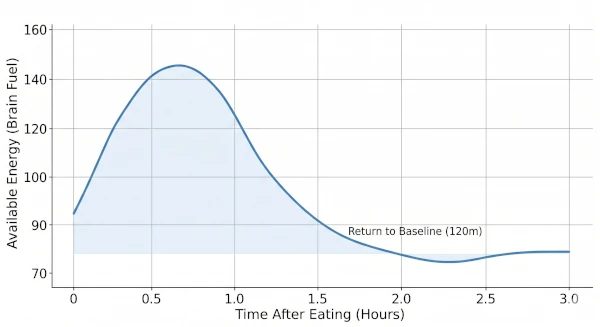
It is pretty much what we’d expect: we eat, glucose levels rise, they hit a peak after about an hour, and after two hours, they settle back to where they started. This is the typical rhythm between meals during a normal day of regular mental activity.
这基本不出我们所料:我们进食,血糖水平上升,大约一小时后达到峰值,两小时后回落到原点。这是在正常日常脑力活动中,两餐之间的典型节奏。
Now, let’s see what happens (still under normal conditions) if we toss a sugary snack into the mix.
现在,来看看我们(在正常状况下)加入一份含糖零食会怎样。
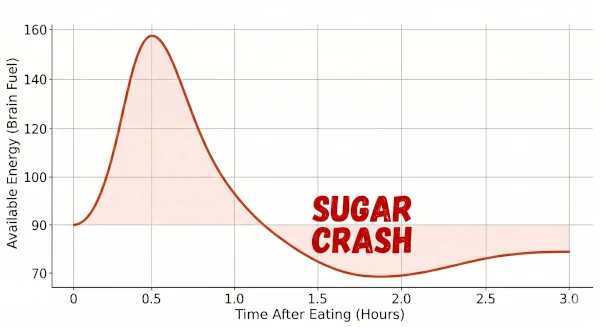
The first difference is that the peak is much higher: we’ve sent a literal flood of glucose into our system in just thirty minutes. In response, our pancreas starts pumping out terrifying amounts of insulin to absorb that sugar as fast as possible. An hour after the snack, there is so much insulin circulating that even after the “glucose emergency” has passed, it just keeps absorbing indiscriminately. So, you grabbed that snack to “give yourself a boost,” but two hours later, you’re actually in worse shape than before. That is the famous sugar crash we so often underestimate.
第一个区别是峰值高得多:我们在短短三十分钟内向体内输送了名副其实的葡萄糖洪流。作为回应,胰腺开始泵出惊人数量的胰岛素,以最快速度吸收这些糖分。零食吃完一小时后,体内仍有大量胰岛素在循环,以至于即便“葡萄糖紧急状态”已经过去,它还在不加区分地继续吸收。所以,你吃零食是为了“提提神”,但两小时后,你的状态其实比之前更糟。这就是我们常常低估的著名“糖分崩溃”。
In other words, all those sweets and biscuits in the room next to the tournament hall at EGP Lucca 2025? Nothing but a diabolical plot by the Italian Federation to sabotage your performance right before the finals.
换句话说,2025年卢卡EGP赛场大厅旁那个房间里摆着的所有糖果和饼干,不过是意大利协会在决赛前破坏你表现的恶毒阴谋。
黑白棋马拉松/The Othello Marathon
Everything we’ve talked about so far describes what happens during your standard, everyday brain activity. But what about when we’re sitting there for hours, literally squeezing our grey matter dry during an Othello tournament? Let’s look at what happens to your glucose levels when you eat simple carbs like bread or pizza while competing.
我们目前聊的一切,都是在描述标准日常大脑活动下的情况。但当我们一连坐上好几个小时,在一场黑白棋比赛中几乎把脑汁绞尽时,又会怎样?我们来看看比赛期间吃下面包或披萨这类简单碳水化合物时,血糖水平会如何变化。
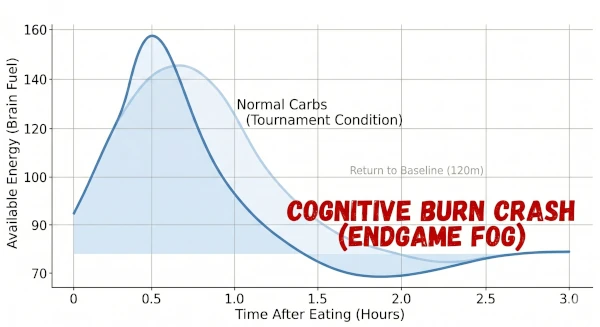
Wait… more glucose than before, even though I ate the same thing? Yup. And there’s a very specific reason for it: tournament adrenaline. It kicks your liver into gear, forcing it to burn through those stored glycogen reserves and pumping even more fuel into your brain.
等等……血糖比之前更高了,尽管我吃的东西一样?没错。这背后有个非常具体的原因:比赛带来的肾上腺素。它会逼迫你的肝脏动起来,烧掉储存的糖原储备,把更多燃料泵进大脑。
However, your brain isn’t exactly taking a leisurely stroll by the lake. It’s sprinting uphill at full speed for an hour. You’re burning through that glucose at a terrifying rate, which makes the post-meal crash even more of a nightmare—pretty much identical to the sugar crash you get from those “sabotage” cookies.
然而,你的大脑可不是在湖边悠闲散步。它正全速冲刺爬坡整整一个小时。你以可怕的速度燃烧着葡萄糖,这让餐后的血糖崩溃更是噩梦一场——几乎和那些“破坏”饼干造成的糖分崩溃一模一样。
And there’s more: if you grab a pizza for lunch, you’re also kicking off a massive, energy-draining digestion process. Your body starts diverting blood flow away from your brain and straight toward your stomach. Digestion is actually one of the most taxing activities the human body can perform. So, while your prefrontal cortex is screaming for a fresh supply of glucose-rich blood, you’ve basically pulled the handbrake on your car while it’s trying to climb a steep hill, all because you just had to have that ham and mushroom pizza. No wonder those final matches of the day often feel like you’re playing through a fog.
而且还有一点:如果你午餐吃了披萨,还会启动一个消耗巨大能量的消化过程。身体开始把血流从大脑直接引向胃部。消化其实是人体所能进行的最繁重活动之一。所以,当你的前额叶皮层尖叫着需要富含葡萄糖的新鲜血液时,你基本上相当于在车子爬陡坡时拉起了手刹,就因为你非要吃那份火腿蘑菇披萨。难怪当天最后几轮比赛常常让人感觉像在迷雾中下棋。
At this point, it sounds like a puzzle with no solution. And honestly? In some ways, it is. But there is actually quite a bit we can do to put ourselves in a much better position to win.
说到这,这听起来就像一个无解的难题。而且老实说,从某些方面看,确实如此。不过,我们还是有不少办法能让自己处于更有利的取胜位置。
冠军饮食/The Champion’s Diet
The secret lies in complex carbohydrates paired with a solid serving of proteins and fats. Unlike the simple stuff, complex carbs—think whole-grain pasta, bread, or cereals—take much longer to break down, which stretches out that glycemic curve. And when you throw fats and proteins into the mix, your digestive system slows down even further, giving that blood sugar curve some serious “stamina.”
秘密在于复合碳水化合物,再搭配足量的蛋白质和脂肪。跟简单碳水不同,复合碳水——比如全谷物意面、面包或麦片——分解起来慢得多,从而拉长了血糖曲线。而当你加入脂肪和蛋白质后,消化系统会进一步放慢速度,给血糖曲线注入十足的“耐力”。
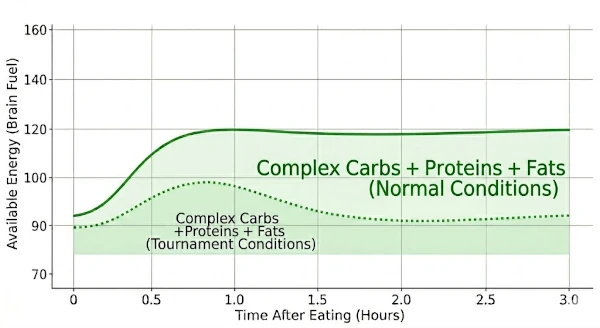
Take a look at that top curve: that is the Holy Grail of brain performance. It’s a steady, reliable level of blood glucose that lasts for hours. Get your breakfast right, and your mind feels fantastic right through the middle of the day.
看最上面那条曲线:那就是大脑表现的圣杯。这是一个稳定、可靠的血糖水平,能持续数小时。只要早餐吃对了,你的大脑在整个上午直到中午都会感觉棒极了。
Of course, if your idea of a “fantastic day” involves an Othello tournament, things get a bit more complicated. We’re back to the car sprinting uphill; your brain is burning through that glucose at an incredible rate. Even so, you’re in much better shape: while you’d be in trouble after two hours on a standard diet, this mix keeps you at a “normal” level much longer.
当然,如果你设想的“美妙一天”包含一场黑白棋比赛,事情就变得有点复杂了。我们又回到了汽车冲刺爬坡的状态;你的大脑正以惊人速度燃烧葡萄糖。即便如此,你的处境也好得多:普通饮食下你可能两小时后就麻烦了,而这种混合吃法能让你在更长时间内保持在“正常”水平。
But for those of us who want to win the World Championship, “normal” isn’t enough. We need to keep the brain flooded with fuel to spot the traps our opponents miss. So, while the complex carb/fat/protein combo is the best starting line, we need one more trick to get us through the final stretch—and that’s something we put into practice while we’re actually sitting at the board.
但对于我们这些想拿世界冠军的人来说,“正常”还不够。我们需要让大脑一直燃料充足,好去发现对手错过的陷阱。因此,虽然复合碳水/脂肪/蛋白质的组合是最佳起点,我们还需要一个额外的窍门来帮我们冲过终点——而这正是我们在真正坐在棋盘前时要付诸实践的。
Enough theory. Let’s talk about real-world experience. At least mine: here is exactly how I eat when I’m competing in an Othello tournament.
理论讲够了。我们来聊聊实战经验吧。至少是我的经验:下面就是我参加黑白棋比赛时吃东西的严格流程。
黑白棋赛场的一天/A Day at the Othello Races
I wake up in the morning, ideally after a solid 7 or 8 hours of uninterrupted sleep. Then, I whip up the breakfast of champions: oats (whole grain is best) mixed with Greek yogurt and honey. This is the perfect trifecta of complex carbs, proteins, and fats. There are other combinations, of course, but since this energy-packed bowl hits the spot for me, I don’t need anything else. Don’t be shy with the portions—this is your engine starting up. We are building the foundation for peak performance for the rest of the day.
我早上醒来,最好是踏踏实实睡足了七八个小时。然后,我做一份冠军早餐:燕麦(全麦最佳)拌上希腊酸奶和蜂蜜。这是复合碳水、蛋白质和脂肪的完美三重组合。当然也有其他搭配,但既然这碗能量满满的东西合我胃口,我就不需要别的了。分量上别太小气——这是你的引擎在启动。我们在为接下来一整天的巅峰表现打基础。
Like most of you, I need my coffee, but on tournament day, I take it strictly without sugar. This is even more vital for those coffees consumed right before a round. Today, added sugars are Public Enemy Number One; I’m not looking for a “crash.” I’ve already got the honey in my breakfast, and that’s more than enough fuel.
和你们大多数人一样,我需要喝咖啡,但在比赛日,我喝咖啡严格不加糖。对于临近一轮比赛前喝的那些咖啡,这点更为重要。今天,添加糖是头号公敌;我可不想招来“崩溃”。早餐里我已经有蜂蜜了,那燃料绰绰有余。
One hour before the tournament kicks off, I eat a banana. It’s the classic marathon runner’s trick: more complex carbs and natural sugars to help “shift into gear” before the clock starts ticking.
比赛开始前一小时,我吃一根香蕉。这是经典的马拉松选手技巧:更多的复合碳水化合物和天然糖分,帮我在计时开始前“挂上档”。
I usually make sure to arrive at the venue after a 30-minute walk. Maybe I park a little further away, or I get off the metro a few stops early. This oxygenates the body, keeps the “digestive slump” at bay, and makes the brain much more sensitive to the glucose it’s about to receive.
我通常都会确保自己步行30分钟到达赛场。也许我把车停远一点,或提前几站下地铁。这能为身体充氧,防止“消化倦怠”,并让大脑对即将接收的葡萄糖更为敏感。
Maintaining the Machine
The tournament begins, and the “uphill climb” starts trying to sabotage all my careful prep by burning through my glucose reserves. To stay sharp, I constantly sip my personal formula: 2/3 water and 1/3 apple juice. Not pure juice—that would be too much sugar and would weigh down my digestion. It needs to be diluted. Our brains need a lot of hydration on days like this, anyway. I prep a liter of this mix in the morning and take a sip almost every move. Usually, one liter is plenty to get through seven hour-long rounds.
At the end of the second round (mid-morning) and again around the fifth or sixth round (mid-afternoon), I have two or three squares of dark chocolate (at least 85% cocoa). This acts as a little “reboot” for the second half of those sessions when the last meal feels like a distant memory.
维持机器运转/The “No-Bread” Lunch Policy
At lunch: zero carbs, only proteins. If the waiter brings a basket of bread to the table, feel free to throw it back at them. Ideally, go for fish—it’s packed with Omega-3s, which are basically gold for your brain. If I’m still hungry after a salmon fillet, I’ll just order a second protein-based dish. Usually, one is enough because that “breakfast of champions” is still doing the heavy lifting. If I skip the second course, I’ll finish with another banana, and that’s that.
比赛开始了,“爬坡冲刺”开始试图通过烧光我的葡萄糖储备来破坏我所有精心准备。为了保持敏锐,我不断小口喝我的私人配方饮料:三分之二水,三分之一苹果汁。不能是纯果汁——那糖分太高,会拖累消化。必须稀释。在这种日子,我们的大脑本来就需要大量水分。我早上会准备好一升这种混合液,几乎每走一步棋都抿一小口。通常,一升足够撑过七轮各一小时的比赛。
One sugarless espresso and the check, please. Then it’s back to the board for the afternoon rounds, armed with my water-juice mix and those last few squares of dark chocolate.
在第二轮结束(上午过半)和第五或第六轮左右(下午过半),我会吃两到三小块黑巧克力(至少85%可可含量)。这算是为这些阶段的后期来一次小小的“重启”,那会儿上一顿饭已经像是遥远的记忆了。
In the end, it looks something like this.
最终,情况看起来像这样。
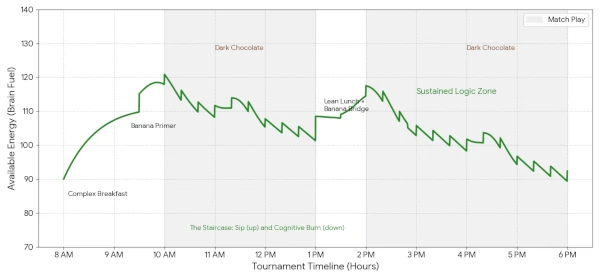
The “Champion’s Breakfast” kicks everything off perfectly. Those sips of the water-juice mix create those little “ripples” on the graph—constant micro-boosts that help you go the distance. Skipping the carbs at lunch prevents a major crash, and the bananas and dark chocolate handle the rest.
“冠军早餐”完美启动了一切。喝下的水-果汁混合液在图表上造成了那些小小的“波动”——持续的微量提升,帮你走完全程。午餐不吃碳水避免了一次大规模的崩溃,而香蕉和黑巧克力则搞定了其余部分。
By the end of the day, I actually feel good. I don’t get that “totally wiped out” feeling I used to have; I finish the tournament feeling pretty much normal. It’s like I’ve been sprinting uphill all day, but I don’t really feel the fatigue.
一天结束时,我实际上感觉很好。我不会有过去那种“彻底被掏空”的感觉;我比完赛差不多觉得精神正常。就好像我冲刺爬了一整天的坡,却并不真觉得累。
This is what works for me. Feel free to experiment and find what fits you best—we can chat about it at the next tournament. Human biology is mostly the same for everyone, but we’re all unique enough that you might discover your own secret tweaks.
这就是对我管用的方法。你们尽管去试验,找到最适合自己的方案——我们可以在下次比赛时聊聊。人类生物学基本大同小异,但我们每个人又都足够独特,说不定你会找到自己独特的微调秘诀。
Of course, you’re always free to keep giving my “magic” tournament bottle suspicious looks while you happily tuck into a big plate of pasta for lunch. Then I hope I’m the one sitting across from you during round six!
当然,你们永远可以继续边用怀疑的目光打量我那瓶“神奇”比赛饮料,边开开心心地吞下一大盘意面当午餐。那么,我希望在第六轮,坐在你们对面的人是我!
